Ad-Hoc Emergency Liquidity - Autos
The Rescue of the US Auto Industry, Module A: Automotive Bridge Loans
Purpose
To finance the day-to-day operations of Chrysler and General Motors through the first quarter of 2009 (the transition period) while ensuring that the companies begin restructuring themselves.
Key Terms
-
Announcement DateDecember 19, 2008
-
Operational DateDecember 31, 2008
-
Expiration DateDecember 31, 2011, for GM and January 2, 2012, for Chrysler (July 10, 2009 for both at the option of the President’s Designee)
-
Legal AuthorityEmergency Economic Stabilization Act of 2008 (EESA)
-
Interest RateThe greater of three-month LIBOR plus 3%, or 5% plus a default penalty (adds an additional 5%)
-
CollateralSenior Liens on all unencumbered assets and junior liens on encumbered assets
-
FunderUS Department of the Treasury
-
ParticipantsGeneral Motors Corporation; Chrysler Holding LLC
-
Initial Commitment$17.4 billion ($13.4 billion for GM and $4 billion for Chrysler)
-
Final Commitment$23.8 billion ($19.8 billion for GM and $4 billion for Chrysler)
In 2008, in the midst of the Global Financial Crisis, America’s Big Three automakers neared their breaking point. Two of them, General Motors (GM) and Chrysler, asked Congress for funding to prevent uncontrolled bankruptcies. Policymakers realized these uncontrolled bankruptcies would damage the manufacturing sector. Congress considered but failed to pass a framework conditioning short-term financing on the companies’ producing acceptable restructuring plans. With the companies warning that they could not survive the coming presidential transition, on December 19, 2008, President George W. Bush announced the Automotive Industry Financing Program (AIFP) under the authority of the Emergency Economic Stability Act (EESA) of 2008, which made up to $17.4 billion available to the two companies. After two extensions to GM, the government would lend a total of $23.8 billion to GM and Chrysler under this program, funding the companies from late 2008 through their mid-2009 bankruptcies (the Bridge Loans). This case discusses these Bridge Loans, which helped the companies survive the presidential transition and begin creating plans to survive bankruptcy.
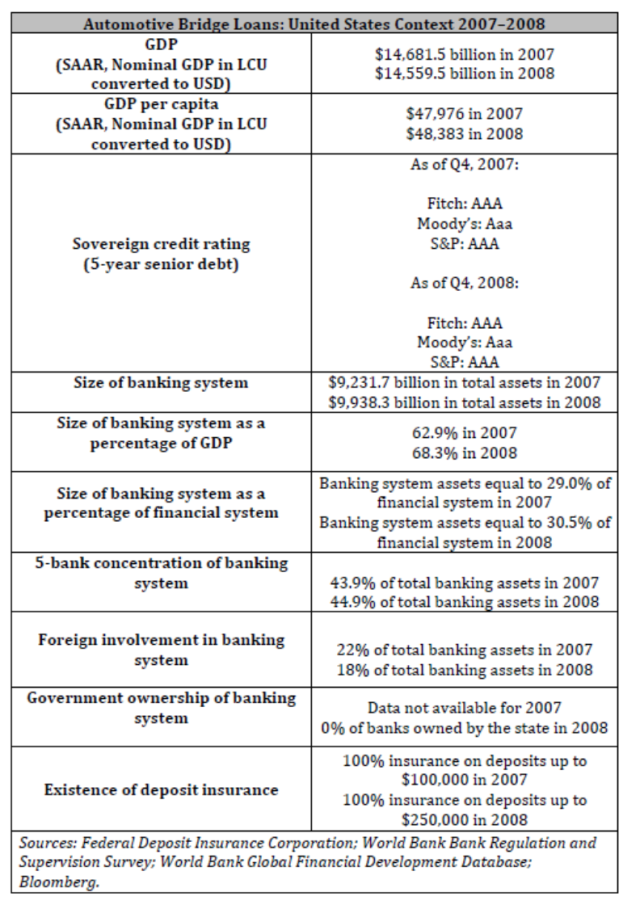
In 2008, due to the confluence of the financial crisis and years of decline, the Big Three American auto companies—General Motors (GM), Chrysler, and Ford—began to experience significant losses and financing constraints. During the lame duck period of George W. Bush’s presidency in late 2008, GM and Chrysler could not find private funding to sustain their operations. Neither of the companies had adequate restructuring plans, and the collapse of the companies would devastate the larger auto industry. Congress did not approve aid to the automakers by winter recess, and it was clear the companies would not survive the coming months without government aid.
The Bush administration determined that the auto companies were eligible for assistance from the $350 billion first tranche of the recently passed Troubled Assets Relief Program (TARP). On December 19, 2008, President Bush announced up to $17.4 billion in Bridge Loans as part of the Automotive Industry Financing Program (AIFP). These Bridge Loans became part of a government rescue of the auto industry, which involved aid to two automotive finance companies, two bankruptcy reorganizations, a warranty guarantee program, aid to auto suppliers, Department of Energy loans for financing the development of fuel-efficient vehicles, “Cash for Clunkers” (a vehicle scrappage program), and a Small Business Administration (SBA) dealer floorplan financing program. Although Ford was also impacted by the financial crisis, it was in a healthier financial position than its peers and chose not to participate in the AIFP. It did, however, participate in a Department of Energy funding program and financial assistance programs such as the Commercial Paper Funding Facility (CPFF).
Many of the terms of the bridge loan agreement closely mirrored those outlined in the Auto Industry Financing and Restructuring Act, which passed the House on December 10, 2008, but failed to pass the Senate.
The Bridge Loans sustained the companies while a comprehensive auto industry restructuring was crafted. They also forced Chrysler and GM to restructure themselves into viable companies and required them to develop and implement long-term viability plans that were evaluated by a “car czar,” a role that ultimately fell to a Presidential Task Force.
In that the borrowers did survive the presidential transition and implemented viability plans, one could argue that the Bridge Loans succeeded. However, the companies did not produce viable plans by the initial deadline. Some observers have questioned whether making the auto companies eligible for TARP went beyond the intent of Congress and whether some of the terms in the loan agreements were effective in protecting taxpayer funds.
There were also criticisms of the government’s design of and rapid exit from the $4 billion bridge loan to Chrysler. Treasury relinquished its claim on 40% of Chrysler Financial’s proceeds for $1.9 billion in May 2010, but some argued that it could have received $600 million more if it had waited until the end of the year (COP 2011, 11).
Key Design Decisions
Legal Authority
1
The Bridge Loans were authorized under EESA as part of the AIFP, which was authorized under the TARP. Although the Bush administration initially argued that EESA did not give it the authority to use TARP funds for aid to the automotive industry, failure to pass a legislative solution forced it to pivot (Canis et al. 2009, 9). On December 23, 2008, Secretary Paulson relied on Sections 101(a)(1), 3(5), and 3(9)(B) of EESA to send an official determination to Congress (Secretary of Treasury 2008). This determination defined “certain thrift and other holding companies which are engaged in the manufacturing of automotive vehicles and the provision of credit and financing in connection with the manufacturing and purchase of such vehicles” as “financial institutions” pursuant to EESA and further defined their assets as “troubled assets” eligible for purchase with TARP funds to promote financial stability (Secretary of Treasury 2008).
During the legal battles associated with GM and Chrysler’s 2009 bankruptcies, the government had to further justify Secretary Paulson’s determination as being in line with the intentions of Congress in passing TARP (COP 2009b, 74–76). In one such instance, the government argued that there was “a certain connection between the automotive companies’ financing entities and the automotive companies themselves that permits the use of TARP funds to support the automotive companies, thereby supporting the companies’ financial divisions” (COP 2009b, 74–76). The Congressional Oversight Panel discussed the validity of the Treasury’s arguments and concluded that the issue “may never be answered with any finality” because it had not been brought to any court for adjudication (COP 2009b, 79).
The Secretary of Treasury did not mention the potential impact of a GM and/or Chrysler collapse on public finances. However, two economic advisors to the Obama administration later said that a Chapter 7 bankruptcy by either company would have transferred billions in liabilities to the government’s Pension Benefit Guarantee Corporation (PBGC), straining its resources, threatening the economic security of thousands of retirees, and probably demanding another taxpayer bailout (Goolsbee and Krueger 2015, 10).
Part of a Package
1
Under the auspices of the AIFP, the government would ultimately provide funding to not only the auto manufacturers but also to other related stakeholders, such as suppliers and customers. Because of the interdependence of companies in the industry, such aid was thought necessary to ensure the restructuring plans and survival of the manufacturers. Assistance was provided to suppliers, to finance companies to maintain financing for new car purchases, and to special purpose vehicles that guaranteed warranties on new cars. The government also helped the two companies restructure using the bankruptcy code, committing billions of dollars in debtor-in-possession and post-petition financing (Klier and Rubenstein 2013, 148150).
Purpose
2
Although AIFP was the formal program authorized by and receiving funding under EESA to assist the auto industry with TARP funds, the program itself served more as a line item that could encompass Treasury’s various loans and investments in the auto industry within TARP documentation. The AIFP appeared on the Treasury website weeks after the Bridge Loans were signed.
Treasury argued that the companies it supported through the AIFP were systemically important. The overall objective of the AIFP as stated in the program guidelines was: “…to prevent a significant disruption of the American automotive industry that poses a systemic risk to financial market stability and will have a negative effect on the real economy of the United States” (Treasury 2014). Treasury said that it had determined eligibility for the AIFP, and the Bridge Loans put forward under it, on a case-by-case basis that took several factors into account (Treasury 2014), including:
- “The importance of the institution to production by, or financing of, the American automotive industry;
- “Whether a major disruption of the institution’s operations would likely have a materially adverse effect on employment and thereby produce negative effects on overall economic performance;
- “Whether the institution is sufficiently important to the nation’s financial and economic system that a major disruption of its operations would, with a high probability, cause major disruptions to credit markets and significantly increase uncertainty or losses of confidence, thereby materially weakening overall economic performance; and
- “The extent and probability of the institution’s ability to access alternative sources of capital and liquidity, whether from the private sector or other sources of US government funds” (Treasury 2014).
The Bridge Loans served two purposes. The first was to ensure the survival of GM and Chrysler through the end of the Bush administration (Paulson 2010, 415–418). The officials designing the Bridge Loans thought that the transition period would be “a barbarically long time to be without adequate resources” and that GM in particular was likely to fail by the end of 2008 without funding assistance from the government since it was experiencing critical difficulty accessing market funding (Paulson 2010, 415–418).
The second purpose was to force the companies to develop sufficient plans for achieving long-term viability, a concept directly embodied in the guidelines: “The program will require steps be taken by participating firms to implement plans that achieve long-term viability.” The Paulson Treasury contemplated survival only as it was accompanied by major restructuring (Paulson 2010, 428).
Achieving long-term viability, however, was complicated by the fact that Chrysler and GM were not just having liquidity problems. GM was technically insolvent; Chrysler may have been as well, but as a private company it was not required to publish its financial statements (Vlasic and Wayne 2008; GM 2009, 140). Companies facing insolvency in ordinary times would try to raise capital and reorganize through the Bankruptcy Code. However, during the financial crisis the two companies lacked the financing and the time for a conventional restructuring (Paulson 2010, 421–424). They would have probably failed to reorganize through a Chapter 11 bankruptcy and found themselves liquidated in a Chapter 7 bankruptcy (Klier and Rubenstein 2013, 147).FThere was also some skepticism as to whether any automaker, no matter their previous strength, would be able to survive a bankruptcy (Rattner 2010). A major reason for the skepticism was the belief that consumers wouldn’t buy vehicles from a bankrupt company out of concern that their warranties would not be honored (Rattner 2010). Even if the companies managed to survive bankruptcy, an expedited bankruptcy would have been complicated by negotiations among the thousands of GM and Chrysler creditors, counterparties, and labor (across multiple countries). It would certainly take longer than the couple months left in the Bush administration (Rattner 2010, 59, 62, 107; Goolsbee and Krueger 2015, 9).
Figure 4: Restructuring Plan Principles
 Sources: GM and Treasury 2008, PDF p. 52; Chrysler and Treasury 2009, PDF p. 6.FBoldface is used here to indicate the fact that policymakers emphasized this principle.
Because officials were concerned that they “would not be around to oversee […] changes” at the two companies, the Bridge Loans had to “put the automakers on a path to reorganization through bankruptcy proceedings,” which required intricate restructuring plans to succeed (Paulson 2010, 428429).FAlthough sources indicate that officials contemplated using bankruptcy as a tool as early as late December 2008 when the Bridge Loans were put in place, this term was not included in official announcements about the AIFP until March 31, 2009 (Paulson 2010, 421–428; Treasury 2009d, 1). This may indicate the willingness to avoid bankruptcy if possible; however, given the market conditions and the conditions of the companies this appeared a limited possibility (Krolicki 2009). These restructuring plans were to be based around five principles (Figure 4). The Paulson Treasury (and later the Geithner Treasury) knew that GM and Chrysler were having difficulty producing realistic plans and might not do so voluntarily (Rattner 2010, 27–32).
On March 30, 2009, Treasury determined that the companies’ submitted plans were not viable and began directly collaborating with them to produce new ones (Treasury 2009a; Treasury Department 2009b). The modified plans were ultimately approved by the government and carried the companies through Chapter 11.
Administration
2
As a part of the AIFP, which itself was part of TARP, the Bridge Loans were administered by a team in Treasury’s Office of Financial Stability (Treasury 2014). Treasury’s auto team drew upon the few automobile industry experts in the federal government but was largely composed of restructuring and bankruptcy experts. The team was “was notable for not including any individual with close ties to the auto industry” (Klier and Rubenstein 2012, 39). The primary reason for this seems to be that the auto rescue was considered a private-equity-style restructuring deal, which tends to rely on non-sectoral financial and bankruptcy expertise (Rattner 2010).
The transnational nature of American auto manufacturing meant that the GM auto companies also advocated for access to foreign government aid for their foreign subsidiaries in 2008 and 2009 (see Embassy Berlin 2009). Perhaps because of these efforts, the Canadian government collaborated with both the outgoing Bush administration and president-elect Obama’s transition team before the December 19, 2008, announcements of the Bridge Loan commitments (Wilson 2008).
On the same day as the Bush administration announced the Bridge Loans, there was an announcement of similar support to General Motors of Canada and Chrysler Canada by the Canadian and Ontario governments. The aid to the Canadian subsidiaries was for 20% of the amount offered to the US auto companies by the US government (C$4 billion, or $3.28 billion).FExchange rate of 1.21 CAN-USD (Office of the Auditor General of Canada 2014) The C$4 billion commitment was never drawn. It was replaced with other assistance measures in spring 2009, when the Canadian subsidiaries requested C$10 billion in aid from central and provincial governments. In response, Canada committed C$1 billion in financing for Chrysler Canada (Chrysler Canada drew on C$250 million of this commitment) and C$3 billion for General Motors of Canada (Export Development Canada 2009, 4; Industry Canada 2009). However, there was extremely limited documentation of the mechanics of how the lending to General Motors of Canada was used (Office of the Auditor General of Canada 2014). The Canadian government continued to use this 20% proportion when deciding the assistance to the two companies throughout 2009 (Export Development Canada, 4). GM evidently did not pledge all of its foreign subsidiaries as collateral, which the US government was aware of and mentioned in at least one diplomatic cable (Consulate General Shanghai 2008).FThe GM Loan and Security Agreement (LSA) lists the broad companies that they did pledge, but the list of companies excluded from the collateral (which could or might have included a number of subsidiaries of companies that they did pledge) was redacted (GM and Treasury 2008, PDF pp. 141–142, 184–190, 206–212).
Maturity
1
The Bridge Loans were scheduled to mature at the earlier of the expiration date, which was in approximately three years unless other designated events occurred sooner: the occurrence of certain standard acts of default at the Lender’s option such as any “Change of Control [occurring] without the prior consent of” Treasury, or the President’s Designee failed to issue a Plan Completion Certification (PCC) after their respective closing dates of December 30, 2011, and January 2, 2012 (Chrysler and Treasury 2009, PDF p. 143; GM and Treasury 2008, PDF pp. 112, 258). The loans tied their maturity to each company’s restructuring progress.
Each loan would mature three years after execution if the President’s Designee signaled acceptance of the company’s viability plan by issuing a PCC by the March 31, 2009, deadline or any permitted extension (GM and Treasury 2008, PDF pp. 67, 71, 106; Chrysler and Treasury 2009, PDF pp. 21, 25, 60). However, the Bridge Loans would terminate on April 30 if the stakeholders could not reach an agreement by March 31. In that case, a company would be obliged to repay all advances and any interest and fees due under the agreement (GM and Treasury 2008, PDF pp. 67, 71, 74, 106; Chrysler and Treasury 2009, PDF pp. 21, 25, 60). This was provision that could exert extra pressure on the stakeholders to achieve a compromise.
The Fact Sheet accompanying the announcement of the Bridge Loans stated that “all funds [would be] returned to the Treasury Department” when the loan was called in the event that a firm did not attain viability by the deadline (White House 2008). This suggests that some believed the companies had the capacity to repay the loans, implying that taxpayers would not lose money on the Bridge Loans if the companies failed to demonstrate viability. However, given the high possibility of bankruptcy, there could be no certainty that even if repaid, the amounts would not be recaptured by the court as preferences.FA “preference” is a payment made by a debtor within some short period before filing for bankruptcy and may be voided and added back into the estate because the debtor here has acted in preference to certain creditors over other similarly situated or superior creditors, contrary to the bankruptcy code’s main tenet of treating similarly situated creditors equally. See Section 547(b) of the US Bankruptcy Code.
Program Size
2
Loan size was a central consideration for the Bush administration (Deese, Shafran, and Jester 2020, 363–368). Proposals for financing the two companies varied from a $10 billion GM loan to a $25 billion loan program for both companies, as there was significant uncertainty as to how much money the companies needed to stay alive (Deese, Shafran, and Jester 2020, 363–368). As announced on December 19, 2008, Treasury initially committed to lend $17.4 billion in short-term financing to GM and Chrysler through the Bridge Loan program, but $4 billion of this was not to be available until February 2009 and was “contingent upon drawing down the final tranche of TARP funds” (White House 2008). The initial White House announcement did not allocate specific amounts to the two companies (White House 2008).
Notwithstanding the contingency related to the $4 billion third advance to GM, the GM Bridge Loan Agreement was written with a maximum commitment of $13.4 billion to be paid to the company in three advances. The first $4 billion advance was paid on execution of the loan agreement (GM and Treasury 2008, PDF p. 262). The $5.4 billion second advance, which also relied on the first $350 billion tranche of TARP, was paid to the company on January 16, 2009 (GM and Treasury 2008, PDF p. 261; COP 2009b, 9). The third $4 billion advance to GM was scheduled for February 17, 2009, and was made conditional on the release by Congress of the second tranche of TARP funds or on Treasury’s finding another source of funds (White House 2008).FThe loan agreement addresses the contingency this way: “The Advance made on the Third Draw Date shall be in an amount equal to $4,000,000,000; provided, that notwithstanding anything to the contrary herein, the Lender’s obligation to make such Advance is conditioned on either (x) the Secretary of the Treasury’s authority to purchase additional Troubled Assets being increased as set forth in Section 115(a)(3) of EESA or (y) the availability to the Secretary of the Treasury of other funding for financial assistance to the automotive industry under Applicable Law” (GM and Treasury 2008, PDF p. 262). While GM did need an immediate $4 billion advance to survive through the New Year, it is not clear why Treasury divided the loan to GM into three advances rather than two. It is also unclear why the date of the second advance to GM was set for January 16, 2009, beyond the fact that it would happen before the inauguration on January 20, 2009.
Treasury allocated Chrysler $4 billion in loans out of the original funding commitment and Chrysler received this amount upon execution of the loan agreement on December 31, 2008 (Treasury 2018).
On March 31, 2009, the Obama administration released its Determinations of Viability, which recognized that the two companies would not be able to provide viable restructuring plans by the Bridge Loan deadline (April 30, 2009). However, the Obama administration judged that the companies were well on their way to completing satisfactory viability plans, so they amended both of the Bridge Loans to provide the companies with more time to submit the plans and committed the necessary working capital to sustain the companies in the meantime. It extended GM’s deadline by 60 days, to June 1, 2009, and extended Chrysler’s deadline by 30 days, to May 1, 2009 (GM and Treasury 2008, PDF p. 296; Chrysler and Treasury 2009, PDF p. 274). Treasury committed to supporting General Motors for 60 days and Chrysler for 30 days (Treasury 2009d, 1). Treasury correspondingly increased the amount of funding for GM by $2 billion on April 22, 2009, and added a further $4 billion in available funding on May 20, 2009 (Treasury 2018). Treasury also made $500 million in additional working capital available to Chrysler, but Chrysler did not take advantage of that offer. However, there was no such increase in funding for Chrysler, as it does not appear that Chrysler requested it (Treasury 2018). The 4th amendment to the loan agreement on May 27, 2008 (see Figure 1) increased the maximum loan amount by $360 million to $19.8 billion.
Other Conditions
4
The first $17.4 billion to GM was to be used for “general corporate and working capital purposes,” but the amended loans providing the $4 billion and $2 billion working capital further restricted the use of funds (GM and Treasury 2008, PDF pp. 301–307, 319–321). These amendments specified that the additional funds would be for only “working capital purposes” and would require a “Use of Proceeds Statement” to accompany each new request for working capital (GM and Treasury 2008, PDF pp. 301–307, 319–321). By restricting financing to “working capital” and requiring that the companies submit a detailed description of how a requested advance would be used, the Bridge Loan documents provided Treasury with an avenue for controlling the minutiae of what the emergency financing would be spent on. This did impose a larger administrative burden, but these new conditions were to affect GM for only 60 days or less, after which GM would enter bankruptcy (Klier and Rubenstein 2012, 42).
The Bridge Loans spread the burden of the restructuring process among GM and Chrysler stakeholders and required concessions from, or imposed limitations on, executives and management, employees and retirees (largely represented by the UAW), unsecured public debtholders, and secured creditors. The union employees and retirees and secured and unsecured debtholders represented most of the companies’ long-term liabilities and would need to make concessions if the companies were to be viable in the long run. Sacrifices for executives and management aimed to reduce the moral hazard associated with the bailout (Knowledge@Wharton 2010).
The Restructuring Plan mandated that management use its best efforts to achieve certain restricting targets including “reduction of the outstanding unsecured public indebtedness (other than with respect to pension and employee benefits obligations) . . . by not less than two-thirds,” implementation of certain significant labor modifications, and implementation of certain Voluntary Employee Benefits Association (VEBA) modifications (GM and Treasury 2008, PDF p. 106).
Labor and VEBA Modifications
The labor modifications were aimed at making GM and Chrysler workers’ compensation and work rules competitive, by December 31, 2009, with those of employees at US locations of Japanese auto companies (Japanese Transplants).FAccording to the GM and Treasury Loan Agreement, “’Compensation Reductions’ shall mean, with respect to the Borrower or any Subsidiary, the reduction of the total amount of compensation, including wages and benefits, paid to its United States employees so that, by no later than December 31, 2009, the average of such total amount, per hour and per person, is an amount that is competitive with the average total amount of such compensation, as certified by the Secretary of the United States Department of Labor, paid per hour and per person to employees of Nissan Motor Company, Toyota Motor corporation, or American Honda Motor Company whose site of employment is in the United States” (See GM and Treasury 2008, Sec. 1.01; also see “Labor Modifications,” “Severance Rationalization,” and Work Rule Modifications). This included reductions in compensation, elimination of any compensation to laid off, fired, furloughed, or idled employees other than customary severance pay, and modification of work rules for employees so that rules applied were competitive with those for employees of Japanese Transplants. The VEBA Modifications required GM and Chrysler to convince the UAW’s Voluntary Employee Benefits Association to accept at least half of its future contributions from GM and Chrysler in the form of company shares (GM and Treasury 2008, PDF p. 72).
Other government bailouts during the crisis did not explicitly place these kinds of burdens on workers, nor did they focus their efforts on protecting workers.FGovernment aid for firms like Bear Stearns and AIG did not include any provisions explicitly impacting the compensation, benefits, pensions and work rules of employees other than executives and management (although there may have been some incidental impact through management decisions) (Wiggins et al. 2021). Further, the terms of the conservatorships and Treasury aid to Fannie Mae and Freddie Mac provided for oversight of executive, but not nonexecutive, compensation. However, labor costs in the auto industry were a significant element that had often been criticized. According to Goolsbee and Krueger (2015), the state of compensation, work rules, and benefit costs (pensions and health care) had made American auto companies uncompetitive with Japanese foreign transplants in the US. They note that the “average labor costs for the Big Three were almost 45 percent higher” than for foreign transplants. From this, they inferred that a successful auto rescue would have had to have “reduced fixed costs associated with retirees and the uncompetitive compensation levels for existing workers” (Goolsbee and Krueger 2015, 8).
By contrast, in some other automobile bailouts, such as the €7 billion ($8.96 billion) French government aid to Renault, Peugeot, and Citroën, the manufacturers were required to keep their domestic factories operating and protect domestic automotive manufacturing jobs while making no mention of employee concessions (Speer 2009).FAt an EUR-USD exchange rate of 1.28;1
Reduction of Unsecured Debt
GM had unsecured public debt of about $27 billion (COP 2009b, PDF p. 124). Chrysler’s unsecured public debt was more limited (GAO 2009, 36–37). The companies were required to make their best efforts to reduce their unsecured public indebtedness by two-thirds via a “Bond Exchange and other appropriate means” (GM and Treasury 2008, PDF p. 106). These terms were meant to make it easier for the companies to impose sacrifices on unsecured public debt holders.
When facing intransigence from unsecured creditors, the President’s Designee could threaten to determine the company unviable, plunging the company into bankruptcy, which would likely impose severe haircuts on, if not entirely wipe out. these unsecured liabilities (GAO 2009, 36–37; Canis et al. 2009, 14–15). However, this threat would only be effective at reducing public indebtedness so long as the general public believed it was still possible to avoid bankruptcy. Since the expectation that the companies would restructure through bankruptcy appeared in Treasury announcement as early as December 2008 (Paulson 2010, 415–428), Treasury might have had to have kept this intention a secret through a presidential transition and three months of negotiating for the requirement to be realistic.
Differentiating them from the bailouts of industrial companies throughout the 1970s, the Bridge Loans did not require or incentivize state or local governments to share the burden of financing the restructuring (General Accounting Office 1984, 44).FIn previous bailouts, these [state and local governments] governments supported the restructuring process by “lower[ing] taxes, offer[ing] loans and industrial revenue bonds, decreas[ing] regulatory burdens, or offer[ing] other advantages that increase the recipient's cash flow and improve its prospects” (1984). Another significant difference from the 1970s bailouts was that the Bridge Loans did not differentiate between foreign and domestic creditors when it came to burden sharing. During the 1979 Chrysler bailout, Treasury negotiated one set of concessions from the 15 largest American bank lenders and different set of concessions from a committee of Japanese and European bank lenders (Reich and Donahue 1985, 245).
Provisions attempting to reduce moral hazard in the Bridge Loans targeted the activities of management in the public eye, which imposed a kind of penance on behalf of management.
Similar to firms participating in the Capital Purchase Program (CPP),FThe CPP was a capital injection program for financial institutions conducted by Treasury between late 2008 and December 2009 (Treasury 2015). auto companies receiving funds from Bridge Loans under the TARP were required to restrict what are known as golden parachutes. Bridge Loans documents contained a definition of golden parachutes broader than the CPP definition. For the CPP, golden parachutes were defined as “payments of more than three times an executive’s average base compensation from a firm over the five most recent years in the event of the official’s involuntary termination, or bankruptcy or receivership of a financial institution” (Treasury 2009f, 28395). The Bridge Loan documents defined golden parachutes as “any payment in the nature of compensation to (or for the benefit of) an SEO [Senior Executive Officer] made on account of an applicable severance from employment” [emphasis added]” (Chrysler and Treasury 2009, PDF p. 58).
The Bridge Loan documents also banned incentive compensation for the 25 most highly paid employees of GM and Chrysler, which goes beyond the restrictions placed on other TARP recipients by late 2008 (Canis et al. 2009, 69–71). This more aggressive measure may reflect a response to the increasing public outrage at “what many perceived to be excessively large bonuses paid to executives from other firms receiving TARP money” (Canis et al. 2009, 71).
The Bridge Loans also contained a provision forcing Chrysler and GM to divest from all private aircraft, a restriction on a kind of executive compensation, which may have been meant to satisfy the public’s desire to punish executives for their actions during their first public requests for public aid in November 2008 (Chrysler and Treasury 2009, PDF p. 59; GM and Treasury 2008, PDF p. 10). On this early trip, the auto executives had traveled to Washington, DC, in separate private jets, an action widely reported on in the media, which made the private jets a symbol of corporate excess. That said, the Bridge Loans left room for corporate travel policies that allowed chartered flights “when supported by a business rationale” (Vlasic 2010).
The Bridge Loans anticipated the bankruptcy of the borrowers by providing that in the event of a bankruptcy filing the Treasury could elect to convert the Bridge Loans into debtor-in-possession (DIP) loans (GM and Treasury 2008, PDF p. 112; Canis et al. 2009, 53–54). In bankruptcies, DIP loans (by definition, loans made to the debtor after a bankruptcy filing) provide the bankrupt organization with the working capital to survive while moving through the bankruptcy process (Canis et al. 2009, 53–54). DIP loans enjoy extremely high priority. If a debtor can demonstrate that it could not secure financing by any other means, a bankruptcy court can authorize a debtor to grant liens to the DIP lender that are senior to liens of all the pre-bankruptcy creditors. In theory, Treasury’s ability to convert the bridge loans to DIP loans would enable it to maintain, or increase, the priority of its loans if one of the borrower companies went into bankruptcy.
Conversion would increase the likelihood that Treasury’s loans would be paid ahead of the other secured creditors, increasing returns to the taxpayers. However, the Congressional Research Service concluded that this conversion provision would go against the very purpose of DIP loans, and even the key tenets of the bankruptcy process, which require that senior creditors be paid before junior creditors (Canis et al. 2009, 54). The converted Bridge/DIP loans would not provide GM or Chrysler with additional working capital, they would keep the bankruptcy court from relieving the debtor of its pre-bankruptcy debts, and they would negatively impact other creditors. Ultimately, the Bridge Loans were not converted to DIP loans and Treasury provided new DIP funding to both companies under a Joint DIP Facility with Export Development Canada, Canada’s export credit agency (COP 2009b, 23–31)
The value of the DIP conversion right was also disputed by at least one commenter. According to Levitin (2008), the courts might reject the provision as an executory contract under 11 U.S.C. §365(c)(2) of the Bankruptcy Code or draw the Treasury into a fight for lien priority in a 11 U.S.C. §364 hearing. If the provision held up in court, GM and Chrysler might have found it more difficult to find additional DIP financing for the restructuring (Canis et al. 2009, 53–54). Although Levitin (2008) contemplated the government’s converting the loan into a DIP loan through a rollup refinancing or a cross-collateralization, he noted that this would probably result in “sharp litigation.” It is difficult to say whether these criticisms would have come to fruition, because the government did not use the DIP loan conversion provision and obtained senior liens through other tactics.
Interest Rate
1
Each loan set the interest rate at the largest of (i) the three-month LIBOR rate as of December 2, 2008 plus 3.00%, or (ii) 5.00% (Chrysler and Treasury 2009, PDF pp. 8, 142–146; GM and Treasury 2008, PDF pp. 74, 258–263). These were seen as significantly below market rates (Brunel and Hufbauer 2009, PDF p. 7). In cases of default, the loan documents imposed a 5.00% interest rate increase as a penalty. The loans did not charge standard fees, such as a commitment fee.
Eligible Collateral
2
Treasury sought first priority liens on all unencumbered assets and junior priority liens on encumbered assets “to the extent legally and contractually permissible” (Canis et al. 2009, PDF pp. 57–58; GM and Treasury 2008, PDF pp. 80–81). While GM had a relatively large amount of unencumbered assets, Chrysler had already encumbered most of its assets with senior liens in two previous secured loans (GAO 2009, 20). Treasury supplemented this with terms that gave it access to senior liens on some of Chrysler’s already encumbered assets, which involved making the loan contingent on Chrysler’s creditors pledging their senior liens on a number of assets to Treasury (Chrysler and Treasury 2009, PDF pp. 142–143, 147–148). However, Treasury was able to receive first priority senior liens on only a small portion of Chrysler’s encumbered real estate and parts inventory, which had a recovery value between $149 million and $261 million (GAO 2009, 20).
The GM Bridge loan was secured by a pledge of “a Lien on and security interest in all of its rights, title and interest in and to all personal property and real property wherever located and whether now or hereafter existing and whether now owned or hereafter acquired, of every kind and description, tangible or intangible” (GM and Treasury 2008, PDF p. 80). In practical terms there was much more in the way of unencumbered assets that could serve as collateral to protect Treasury’s loan to GM, which resulted in Treasury’s obtaining first priority senior liens on much of the collateral, “cash, inventory, real property, equity in domestic and foreign subsidiaries, and intellectual property,” and junior priority liens on collateral subject to a Senior lien permitted under the agreement (GM and Treasury 2008, PDF p. 80; GAO 2009, 20). GM told the GAO that the assets it had provided to the Treasury as collateral would have been sufficient to support similar funding from commercial lenders in normal times but did not provide data to support that statement. Treasury said it could not put a dollar value on the collateral it accepted from the two companies because of volatile market conditions (GAO 2009, 20).
GM was able to use the common and preferred shares it held in its finance company subsidiary, GMAC LLC, as collateral for the Bridge Loan. This required the consent of GMAC’s other shareholders, who included GMAC senior executives and an affiliate of Cerberus, a private equity fund. (GM and Treasury 2008, PDF p. 265).
In March 2009, when the Obama administration amended its loans with the two companies, neither amendment improved Treasury’s position among the creditors or expanded Treasury’s access to collateral ( GM and Treasury 2008, PDF p. 296; Chrysler and Treasury 2009, PDF p. 274). It would have been difficult for the Treasury to expand its access to collateral, as Treasury had already secured as much collateral as it legally could on the Bridge Loans (GAO 2009, 20). There is little chance that there were any assets unencumbered, and newly generated or acquired assets were already automatically covered by pledge (GM and Treasury 2008, PDF p. 80; Chrysler and Treasury 2009, PDF p. 34–35).
When contemplating an exit from Chrysler Financial, Treasury did limited due diligence and “relied primarily on a valuation premised on the wind-down assumption” (COP 2011, 11). Under the wind-down assumption, Chrysler Financial would remain in survival mode, originating as few new auto loans as possible and shrinking operations to pay off outstanding liabilities. By restricting themselves to a wind-down assumption, Treasury rejected the possibility that Chrysler Financial had much value as a going concern when it sold its interest to Cerberus later that year. While Treasury received $1.9 billion, more than what the company was worth under the wind-down assumption, this proved to be $600 million less than the $2.5 billion that Treasury would have netted when the firm was sold to TD Bank Group if it had retained such interest and if the parties had agreed to similar terms (COP 2011, 11).
Treasury described this exit as receiving “less than face value [, but] significantly more than the Treasury expected to recover on this loan and […] greater than an independent valuation of the loan” (Treasury 2010). They explained the low expectations by pointing to “the uncertainty regarding the amount and timing of any income distributions by Chrysler Financial that would be applied to the loan” (Treasury 2010). In the same press release, Treasury gave the public some good news: it announced that “total TARP repayments now stand at $189 billion—well ahead of last fall’s repayment projections for 2010” (Treasury 2010).
Fees
1
Under the law that created TARP, Treasury was mandated to receive some type of warrant or some other type of additional security as consideration. The warrant and additional note policies in the Bridge Loans were more complex than other TARP programs in that the government received both warrants and additional security.FSee EESA 2008, Sec. 113(d). This requirement emerged from various lessons learned from bailouts of the late 1970s. Namely, that the government could obtain risk compensation for its aid through equity participation; for example, receiving warrants, as it did in its support for Chrysler in the late 1970s. In that circumstance, the government, which had guaranteed certain Chrysler borrowing and received warrants for its assistance, ultimately sold the warrants back to the company at a profit (General Accounting Office 1984, v-vi).
In the case of Chrysler, which was privately held, Treasury received additional promissory notes (Additional Notes) for 6.67% of the “Maximum Loan Amount” (in other words, the $4 billion committed to Chrysler) (Chrysler and Treasury 2009, PDF p. 142). This meant that Chrysler would owe roughly $4.3 billion in total on the $4 billion it borrowed from Treasury.
In the case of GM, which was publicly traded, Treasury received a warrant to purchase common shares equal to 20% of the “Maximum Loan Amount” ($13.4 billion) based on the average closing price of the company’s stock during the 15 days ending December 2, 2008. The number of shares could be adjusted to limit dilution (GM and Treasury 2008, PDF p. 2). The Bridge Loans capped Treasury’s stake at 19.99% of GM’s total common equity prior to the exercise of the warrants. If that provision prevented Treasury from purchasing common shares equal to a full 20% of the Maximum Loan Amount, Treasury would receive an additional promissory note similar to Chrysler’s. This Additional Note would be in an amount equal to 6.67% of the Maximum Loan Amount minus one-third the value of the common shares Treasury had received on the exercise of the warrants (GM and Treasury 2008, PDF p. 2).
It is not clear why December 2, 2008, was chosen as the reference date but December 2 was the date that lawmakers requested the submission of Restructuring Plans from the automakers during the hearings that preceded the drafting (and eventual failure) of AIFRA (Kim 2008).
The Congressional Hearings in the weeks before the bailout as well as the past use of warrants can better illustrate the reasoning behind the warrant requirement and the exception for private companies. In the 1980s, the government was able to achieve a return to taxpayers on its 1979 Chrysler loan guarantee by including 14.4 million warrants to buy Chrysler stock for $13 per share until 1990, which the government sold back to Chrysler for $311 million in 1983 (General Accounting Office 1984, 1617, 2930). However, the warrants would protect taxpayers only if the businesses did not fail, there was a market for the warrants, or the stock value exceeded the warrant exercise price.
In a hearing before the Senate Committee on Banking, Housing, and Urban Affairs, Senator Tom Carper made a case that the government should “do warrants […] or something akin to warrants” that would provide some kind of benefit to the taxpayers for the substantial risk of rescuing the struggling automaker, but he was unsure of how to do this for privately held companies like Chrysler (Senate Banking Committee 2008, 86). The reasoning for Senator Carper’s sentiment may be that “valuing a warrant in a private company is difficult” (Schiffer and Fraley 2008, PDF p. 5). Receiving Additional Notes avoided these difficulties while preserving a benefit to taxpayers in the case that the companies did not fail.
Each time that Treasury increased the Maximum Loan Amount (the two successive amendments to the GM loans that increased the amount by $2 billion and $4 billion, respectively), Treasury received warrants and Additional Notes in related amounts (GM and Treasury 2008, PDF p. 300–321). These warrants and notes were effectively the only financial security, beyond the interest payments, that the government received in return for extending the term of and the authorized amount loaned to GM.
Restructuring Plan
3
The Bridge Loans’ Restructuring Plan requirements were designed to fulfill the second purpose of the program: to force GM and Chrysler to make the plans needed to survive both bankruptcy proceedings and the long-term aftermath of those proceedings. The Bush administration did not have the political capital or the time to design and effect a complete restructuring of the companies but wanted to ensure that the Obama administration would have a foundation on which to build a long-term solution (Paulson 2010, 425–428).
The mid-February due dates for the Restructuring Plans and the March 31 Certification DeadlineFAlthough the plans were submitted in February, there is evidence that the companies continued to negotiate with their stakeholders to improve their plans after that date. imposed short timelines on the automakers to secure concessions.FThe short deadlines dovetailed with Treasury Secretary Paulson’s desire to “make it difficult for President Obama to avoid [restructuring through bankruptcy]” (Paulson 2010). However, the deadlines could have easily been altered by the Obama administration through amendments to the Bridge Loan documents. Additionally, the March 31 Certification Deadline had an impact on negotiations because negotiations continued from the Determination of Viability through the April 30, 2009, bankruptcy filing (see Kolka 2009, 37). This would have conceivably put pressure on the stakeholders in GM and Chrysler to participate in developing sufficient Restructuring Plans, since an unsatisfactory plan would have terminated the Bridge Loans and likely would have led to the companies’ bankruptcies (GM and Treasury 2008, PDF p. 296; Chrysler and Treasury 2009, PDF p. 274).FThis was not the case, as the Obama administration determined that the Restructuring Plans submitted in February were not viable by March 30, 2009, and that the companies would not be able to produce viable restructuring plans within the one-month deadline extension (to April 30, 2009) originally allowed by the Bridge Loans.
To ensure that the restructuring plans would actually force GM and Chrysler to make the required preparations for a successful bankruptcy, the Bush administration set down five outcomes the plans would have to achieve. Although the loan agreements did not differentiate between the criteria, other commentators (such as the Congressional Oversight Panel) have pointed out that they seem to fit into two categories: (i) conditions pushing the restructuring to advance US energy policy, and (ii) conditions describing the business aspects of a successful restructuring.
This first category contains a single outcome, which was compliance with environmental requirements and the production of more green vehicles (defined as Advanced Technology Vehicles in line with the Energy Independence and Security Act of 2007).
This second category contains the other four outcomes:
- the repayment of all financing from the US government,
- the achievement of a positive net present value,
- a competitive product mix and cost structure competitive in the US, and
- the rationalization of manufacturing workforce, supplier, and dealership costs, capitalization, and capacity.
The last outcome targeted the costs, capitalization, and capacity of the “manufacturing workforce, suppliers and dealerships.” While the achievement of a positive net present value and the ability to repay the government funding were considered more easily measurable outcomes, the other outcomes depended on concepts that were less clearly defined (GAO 2009, 16). Achievement of these more objectively measurable outcomes became what Treasury referred to as “Financial Viability,” which became its most important indicator of long-term viability (COP 2009b, 9). Some outcomes may have been at odds with those quantifiable financial viability measures; at least in the short term, in particular, the financial costs of producing green vehicles would likely exceed the revenues generated (Government Accountability Office 2009, 16).
Under the Bridge Loans, the President’s Designee would receive the Restructuring Plan to be submitted by February 17, 2009, as well as the Restructuring Plan Report to be submitted no later than March 31, describing progress made under the plan (GM and Treasury 2008, PDF p. 106). Then, the President’s Designee would judge the viability of the company in question, based on the Restructuring Plan Report and the Restructuring Plan, and subsequently decide whether to issue a Plan Completion Certification (PCC) by the Certification Deadline of March 31. If the President’s Designee issued the PCC by the Certification Deadline, the loans would continue in effect until their expiration dates of December 30, 2011 (for GM) and January 2, 2012 (for Chrysler)(Chrysler and Treasury 2009, PDF p. 143; GM and Treasury 2008, PDF p. 258). If the President’s Designee did not issue the PCC by the Certification Deadline, the loan would automatically accelerate, becoming due in 30 days and most likely forcing the company into bankruptcy. This Certification Deadline could be extended for up to 30 days by the President’s Designee without having to amend the Bridge Loan (GM and Treasury 2008, PDF p. 296; Chrysler and Treasury 2009, PDF p. 274).
The Bush Administration envisioned that there would be a single President’s Designee (informally approved by then president-elect Obama) appointed by President Bush to oversee the loans. However, senior staffers from the Obama transition team instead opted for a “one president at a time” approach and declined to participate in this selection (Rattner 2010, 32–35). Therefore, the role of President’s Designee reverted to the Secretary of the Treasury. Additionally, public opinion on the prospect of a car czar was negative and remained so for the first month of the Obama administration (Rattner 2010, 32–33, 51–56, 63–66).
President Obama announced that the role would be filled by the Presidential Task Force on the Auto Industry on February 16, 2009 (a day before the deadline for submitting the Restructuring Plans) (Klier and Rubenstein 2013, 146–147). This was legitimized by the fact that the Bridge Loan documents did not specify that the President’s Designee had to be one person (Chrysler and Treasury 2009, PDF p. 22; GM and Treasury 2008, PDF p. 68). This Presidential Task Force was co-chaired by the Secretary of Treasury and the Director of the National Economic Council in the Office of the President (Klier and Rubenstein 2013, 146–147). However, the day-to-day administration of the Bridge Loans and the staffing for the Presidential Task Force fell to the Treasury auto team, which was led by two appointed advisers that reported to the Presidential Task Force, Ron Bloom and Steven Rattner (COP 2009A, 10-11; Klier and Rubenstein 2012, 38-39; Knowledge@Wharton 2010).FRon Bloom was an investment banker who came from a labor background and was, “in effect, the United Steelworkers’ chief restructuring officer” in the late 1990s (Rattner 2010, 56). Rattner came from a private equity background and had been considered by the Obama administration to be the leader of the team (Geithner 2014, 258-262).
Just as envisioned by the Bush administration, the collective President’s Designee did enjoy wide-ranging administrative leverage over the restructuring process through its ability to review a number of company actions and its power to trigger the loan’s termination by determining the company’s viability (Chrysler and Treasury 2009, PDF pp. 19, 58–61, 68). Specifically, the Designee had the authority to approve bonuses to senior employees, reject transactions involving over $100 million, approve material changes to the company expense policy, receive required notices from the borrower, and generally conduct oversight (Chrysler and Treasury 2009, PDF pp. 19, 58–61, 68).
Throughout the term of the Bridge Loans, the President’s Designee (who would be the Secretary of Treasury if the President did not select a Designee) would administer the companies’ pathways to viability, Restructuring Plans, Restructuring Reports, and compliance (Chrysler and Treasury 2009, PDF pp. 19, 58–61, 68).
When the President’ Designee determined, on March 30, 2009, that GM’s Restructuring Plan was not viable, its auto team adopted a policy of working closely with GM to produce a “more aggressive plan” (Rattner 2010, 208–210; COP 2009b, 1–3; Treasury 2009e). While Treasury worked closely with GM in negotiating terms with stakeholders and helping to revise their plans, Treasury attempted to ensure that it did not appear that the government was itself producing or revising the plans.
This approach might not have been in line with a bailout best practice identified by the General Accounting Office in 1984, which noted:
When the government rejects a proposed plan or contract because it is too risky, it should require the firm’s or municipality’s management to make changes and resubmit the proposal, but the government should not attempt to develop its own plans and impose them on management. To do so could leave the government responsible for the outcome (57).
Eligible Institutions
1
Unlike the French government’s bailout of its auto sector, aid under the Bridge Loans did not extend to suppliers and dealerships; nor did it seek concessions from such stakeholders (Speer 2009). This is not in line with the General Accounting Office’s 1984 recommendation that, “Suppliers whose main or only customer is the distressed firm or municipality should make financial concessions” (43). The substantive elements of the Bridge Loans ignored suppliers and dealerships, even though some of the proceeds of the loans would likely pay various debts owed to suppliers and dealerships.
Debates over the auto rescue in the Senate also mentioned suppliers and dealerships (alongside management, labor, and creditors) as two parties that would make concessions (Senate Banking Committee 2008, 7). Rattner (2010), however, notes that from a very early stage, restructuring would have entailed the reduction of dealerships. Instead of explicitly requiring dealership closures in the Bridge Loans, there appears to have been an expectation that dealership reductions would occur organically (59, 194).
Treasury eventually did provide aid to the suppliers under a program separate from the Bridge Loans, but not immediately (COP 2009b, 22). It is not clear why the government did not initially take a more comprehensive approach to assisting the auto industry, including suppliers and dealers, as some other countries did, or immediately extend benefits to struggling suppliers instead of waiting until March 19, 2009, to announce an auto supplier program (COP 2009b, 29). As for the issue of the dealerships, GM and Chrysler eventually did shrink their dealership networks in the aftermath of the respective bankruptcies (Goolsbee and Krueger 2015, 17–18).
Exit Strategy
1
The Bridge Loans contained numerous terms that terminated the lending facility with the two automakers. The Bridge Loans terminated upon any “Events of Default,” which the two Loan and Security Agreements (LSAs) defined broadly (Chrysler and Treasury 2009, PDF p. 64; GM and Treasury 2008, PDF p. 110-112). Once terminated, the relevant borrower would have to repay “the aggregate principal amount of all Advances then outstanding under the Note, together with all interest thereon and fees and out-of-pocket expenses of the Lender” by the thirtieth day after the Certification Deadline, when the outstanding amounts would become “become due and payable […] without any further action on the part of the Lender” (Chrysler and Treasury 2009, PDF p. 28; GM and Treasury 2008, PDF p. 74).
Communication
1
Treasury made most of the documents underpinning the Bridge Loans and its lending activities associated with Bridge Loans public on its website (Chrysler and Treasury 2009; GM and Treasury 2008; Treasury 2018). It also issued a few press releases on the Presidential Task Force on the Auto Industry’s activities and on its determinations regarding the February viability plans (Treasury 2009c; Treasury 2009a; Treasury 2009b). The latter explained the government’s thinking on how an effective restructuring process would proceed as well as on the problems with the February viability plans.
Commentators acknowledge that the two auto companies did survive the presidential transition as a result of the aid and, with an extension and additional assistance from the Treasury, Restructuring Plans for their long-term viability were produced. The Congressional Oversight Panel (2011) concluded that there is little doubt that GM and Chrysler would have faced the prospect of bankruptcy and liquidation in absence of government aid (115). This is also the position of former government officials involved in the bailout (see Goolsbee and Krueger 2015, 9). However, two members of the Congressional Oversight Panel, in concurring opinions, disagreed with this conclusion. They argued that a private-sector reorganization with some potential debtor-in-possession financing from the government could have secured the necessary resources for restructuring. They argued that such a restructuring would have been possible before the private sector was spooked by signals of an impending government bailout (COP 2011, 122).
Ultimately, the pressure of the initial restructuring plan requirements and the timeline put forward by the Bush administration did not extract viable restructuring plans from the companies. The government had to take a hands-on role in developing the plans and commit additional working capital to keep the companies afloat during the process (Rattner 2010, 157–159, 186–187).
Other commentary on the Bridge Loans addressed Treasury’s transparency in administering the Bridge Loans, the legality of the Bridge Loans, and the effectiveness of provisions meant to protect taxpayers.
The Congressional Oversight Panel (2009b) stated that Treasury’s public statements were relatively vague on what the primary purpose of the Bridge Loan portion of the bailout was, but this complaint was also applied to the auto bailout as a whole (4). This was not in line with the 1984 General Accounting Office recommendations for the rescue of large firms, which emphasized that goals and objectives should “identify intended benefits, including expected levels of attainment; identify unavoidable adverse consequences or […] unintended benefits, […] include to the extent possible measures of desired degree of attainment; and provide guidance to administrators on how to make trade-offs among conflicting aims” (37).
As for the legality of the aid, some argue that by interpreting EESA broadly enough to justify aid to the auto companies, the Bush and then the Obama administrations went beyond Congress’s intent, which was for EESA to assist the financial industry (COP 2009b, 78–79). The Congressional Oversight Panel (2009b) was not sanguine about the legality of using TARP funds, as they said that the debate over AIFRA showed EESA was never intended to cover automobile companies; Congress would not have had to debate AIFRA if it had (78–79). Ultimately, this legality question hinged on a provision of TARP that gave the Secretary of Treasury significant discretion when determining whether a financial institution was systemically important (those being the institutions eligible for TARP funds).
Others noted that the Bridge Loans might have been a violation of the World Trade Organization’s (WTO) Agreement on Subsidies and Countervailing Measures (Benson 2009, 117–118). This could have exposed the US to countervailing duties from abroad or cases before the WTO’s dispute settlement mechanism (Benson 2009, 117–118). One reason for this is that the loans to the two companies were provided at significantly below-market rates (Brunel and Hufbauer 2009, 7). However, a WTO case might have triggered tit-for-tat countervailing tariffs, and the environmental terms of the Restructuring Plans would make bringing a WTO case extremely controversial (Brunel and Hufbauer 2009, 7–8).
In the days before the Treasury executed the Bridge Loans, bankruptcy law commentator Adam Levitin (2009) argued that several terms in the Chrysler agreement would not have provided sufficient protection for taxpayer funds. While the loans were supposed to be secured under the Bridge Loans’ terms related to collateral, they predominantly created junior liens that were likely to “be underwater from the start” in the case of Chrysler. He also argued that the government could have secured higher-quality collateral in negotiations before the Bridge Loans for Chrysler were executed. Levitin also speculated that the low-quality collateral the government actually received senior liens on would have such a limited liquidation value that it could only protect taxpayers through its hostage value.
There are also several criticisms directed at the government’s exit from its stake in Chrysler Financial’s profits. As with the auto bailout as a whole, the Congressional Oversight Panel (2011) felt that the government’s exit from Chrysler Financial had transparency problems. However, the Congressional Oversight Panel also faulted Treasury for carrying out limited due diligence in its decision to exit Chrysler Financial, describing the exit as “hasty” (2). The Congressional Oversight Panel went on to claim that Treasury appeared to have sacrificed “taxpayer returns […] in favor of an unnecessarily accelerated exit” (2).
In general, however, the decision to rescue the auto companies seems to have been viewed positively. Public opinion on the Bridge Loans is difficult to judge, as multiple lending programs were layered on top of the Bridge Loans to provide a more comprehensive funding structuring over time. In December 2008, 60% of consumers surveyed agreed “that the US government should keep loaning money to GM and Chrysler,” but this number dropped to 25% in February 2009 before gradually climbing to 38% by June 2014 (Wallace 2014; First Research 2009, PDF p. 4). Although UAW leadership was initially upset about the required concessions and hoped that they would be retracted by the president-elect, they later supported the bailout process (Canis et al. 2009, 11).
- Adrian, Tobias, and Ernst Schaumburg. 2012. “The Fed’s Emergency Liquidity Faci…
- Benson, Christina C. 2009. “US Auto Industry Bailouts: Will Protectionist Potho…
- Board of Governors of the Federal Reserve System (Federal Reserve). 2009. Feder…
- Brunel, Claire, and Gary Clyde Hufbauer. 2009. “Money for the Auto Industry: Co…
- Bureau of Economic Analysis (BEA). 2019. “Motor Vehicle Retail Sales: Domestic …
- Canis, Bill, and Brent D. Yacobucci. 2015. “The Advanced Technology Vehicles Ma…
- Canis, Bill, James M. Bickley, Hinda Chaikind, Carol A. Pettit, Patrick Purcell…
- Chrysler LLC and Treasury Department (Chrysler and Treasury). 2009. “Chrysler O…
- Congressional Oversight Panel (COP). 2009a. “Oversight of TARP Assistance to th…
- ———. 2009b. “September Oversight Report: The Use of TARP Funds in the Support a…
- ———. 2011. “January Oversight Report: An Update on TARP Support for the Domesti…
- Consulate General Shanghai. 2008. “Shanghai GM Relatively Immune from GM Financ…
- Deese, Brian, Steven M. Shafran, and Dan Jester. 2020. “The Rescue and Restruct…
- Emergency Economic Stabilization Act of 2008 (EESA). Public Law 110-343, 122 St…
- Embassy Berlin. 2009. “GM Calls For State Funds In Opel Plan: Germans Wary.” Wi…
- Export Development Canada. 2009. “Canada Account Annual Report for the Governme…
- First Research. 2009. “Automobile Manufacture – Quarterly Update 3/23/2009.”
- Geithner, Timothy F. 2014. Stress Test: Reflections on Financial Crises. New Yo…
- General Accounting Office. 1984. “Guidelines for Rescuing Large failing Firms a…
- General Motors Corporation (GM). 2009. “Form 10-K: Annual Report Pursuant to Se…
- General Motors Corporation and Treasury Department (GM and Treasury). 2008. “Ge…
- Goolsbee, Austan, and Alan Krueger. 2015. “A Retrospective Look at Rescuing and…
- Government Accountability Office (GAO). 2009. “Auto Industry: Summary of Govern…
- Industry Canada. 2009. “The Governments of Canada and Ontario Reject Automakers…
- Kim, Soyoung. 2008. “Winners in Auto Bailout Could Be Suppliers.” Reuters, Nove…
- King, Jr., Neil, and Jeffrey McCracken. 2009. “U.S. Forced Chrysler’s Creditors…
- Klier, Thomas H., and James Rubenstein. 2012. “Detroit Back from the Brink? Aut…
- ———. 2013. “Restructuring of the U.S. Auto Industry in the 2008-2009 Recession…
- Knowledge@Wharton. 2010. “Road Trip: An Insider’s Account of the Auto Industry …
- Kolka, Ronald A. 2009. “Affidavit of Ronald E. Kolka in Support of First Day Pl…
- Krolicki, Kevin. 2009. “US Auto Panel Aide Says Bankruptcy Not Goal-report.” Re…
- Levitin, Adam. 2008. “More on the Auto Bailouts.” Credit Slips (blog), December…
- ———. 2009. “Treasury Recognizes GM/Chrysler Loan SNAFU.” Credit Slips (blog), F…
- Office of Management and Budget (OMB). 2009. “A Citizen’s Guide to the 2009 Fin…
- Office of the Auditor General of Canada. 2014. “Chapter 5—Support to the Automo…
- Paulson, Henry M., Jr. 2010. On the Brink: Inside the Race to Stop the Collapse…
- Rattner, Steven. 2011. Overhaul: An Insider’s Account of the Obama Administrati…
- Reich, Robert B., and John Donahue. 1985. New Deals: The Chrysler Revival and t…
- Rogers, David. 2008a. “Treasury Wants Rest of Bailout Money.” Politico, Novembe…
- ———. 2008b. “Bernanke: Don’t Count on Fed.” Politico, December 9, 2008.
- Schiffer, Mike, and Bob Fraley. 2008. “Warrants: Key Issues and Current Practic…
- Speer, Lawrence J. 2009. “PSA and Renault Win Bailout Funds from French Governm…
- TD Auto Finance. 2015. “History.” Webpage. Accessed July 1, 2020.
- Treasury, US Department of, Secretary of Treasury (Secretary of Treasury). 2008…
- Treasury, US Department of (Treasury). 2009a. “Determination of Viability Summa…
- ———. 2009b. “Determination of Viability Summary General Motors Corporation.”
- ———. 2009c. “Geithner, Summers Convene Official Designees to Presidential Task …
- ———. 2009d. “Obama Administration New Path to Viability for GM & Chrysler.” Fac…
- ———. 2009e. “Obama Administration Auto Restructuring Initiative Chrysler-Fiat A…
- ———. 2009f. “TARP Standards for Compensation and Corporate Governance; Interim …
- ———. 2010. “Chrysler Financial Parent Company Repays $1.9 Billion in Settlement…
- ———. 2014. “Auto Industry Program Overview.” December 22, 2014.
- ———. 2015. “Capital Purchase Program: Program Purpose & Overview.” October 16, …
- ———. 2018. “Troubled Asset Relief Program Transactions Report – Investment Prog…
- Senate, United States (Senate). 2008. “S.3688 – A bill to provide for additiona…
- Senate, United States, Committee on Banking, Housing, and Urban Affairs (Senate…
- Vlasic, Bill. 2010. “General Motors Can Fly Again for Stock Sale.” New York Tim…
- Vlasic, Bill, and Leslie Wayne. 2008. “Auto Suppliers Share Anxiety Over a Bail…
- Wallace, Gregory. 2014. “Auto Bailout Still Largely Unpopular.” CNN Business, J…
- The White House. 2008. “Fact Sheet: Financing Assistance to Facilitate the Rest…
- Wiggins, Rosalind Z., Aidan Lawson, Steven Kelley, Lily S. Engbith, and Andrew …
- Wilson, Michael. E-mail to John Podesta, December 16, 2008.
Key Program Documents
-
Indicative Summary of Terms for [Chrysler] Secured Term Loan Facility
Treasury document outlining the initially proposed terms of lending to Chrysler.
-
Indicative Summary of Terms for [GM] Secured Term Loan Facility
Treasury document outlining the initially proposed terms of lending to General Motors.
-
(Treasury Department 2009d) Obama Administration New Path to Viability for GM & Chrysler (March 31, 2009)
Summary fact sheet of Determinations of Viability for Chrysler and GM as well as the government framework for restructuring going forward.
-
(Chrysler and Treasury 2009) Chrysler Original Loan and Security Agreement (with amendments) (January 2, 2009)
Agreements (including amendments) to execute lending to Chrysler by Treasury.
-
(GM and Treasury 2008) GM Original Loan and Security Agreement (with amendments) (December 31, 2008)
Agreements (including amendments) to execute lending to General Motors by Treasury.
-
(Secretary of Treasury 2008) Determination, December 19, 2008, and Letters from Henry M. Paulson, Jr., to Members of the House of Representative, December 23, 2008
Determination and letters written by Secretary Paulson that defined the obligations of domestic automotive companies as “troubled assets” eligible for purchase under TARP.
-
(Treasury 2009a) Determination of Viability Summary Chrysler, LLC (March 30, 2009)
Short evaluation of Chrysler’s viability plan as well as the conditions under which the government will grant Chrysler further funding.
-
(Treasury 2009b) Determination of Viability Summary General Motors Corporation (March 30, 2009)
Short evaluation of GM’s viability plan as well as the conditions under which the government will grant GM further funding.
-
(Deese, Shafran, and Jester 2020) “The Rescue and Restructuring of General Motors and Chrysler”
Chapter written by former officials tasked with the auto restructurings during the Obama and Bush administrations.
-
(Goolsbee and Krueger 2015) “A Retrospective Look at Rescuing and Restructuring General Motors and Chrysler”
Analysis of the government’s involvement in the auto sector by two economists involved in the Obama administration’s Council of Economic Advisors.
-
(Klier and Rubenstein 2012) “Detroit Back from the Brink? Auto Industry Crisis and Restructuring, 2008–11”
Federal Reserve Bank of Chicago analysis of the declining auto industry and US government interventions in the industry during the financial crisis that also touches on the changing geography of automotive production in the US.
-
TARP Standards for Compensation and Corporate Governance (06/15/2009)
Rule made by Treasury outlining the executive compensation and corporate governance requirements with which TARP recipients must comply.
-
Text of the Auto Industry Financing and Restructuring Act of 2008 (AIFRA), H.R.7321
Text of the failed Auto Industry Financing and Restructuring Act as received in the Senate on 12/11/2008.
-
(Industry Canada 2009) “The Governments of Canada and Ontario Reject Automakers' Restructuring Plans” (03/30/2009)
Joint press release by the Canadian and Ontarian governments announcing details of the limited bridge financing they would offer to Chrysler Canada and General Motors of Canada. All of this financing was to be coordinated with the United States’ auto rescue efforts.
-
Secretary Paulson Statement on Stabilizing the Automotive Industry (12/19/2008)
Treasury announcement of support for the auto industry under TARP; it contemplates that the process will be discussed with Congress and President Obama’s transition team.
-
Statement by Timothy F. Geithner, US Secretary of the Treasury before the Senate Banking Committee, May 20, 2009
Treasury Secretary Geithner’s statement of May 20, 2009, outlining the state of the economy and including a detailed section on the actions taken to date by the Obama administration on the auto industry.
-
(Treasury Department 2009e) Obama Administration Auto Restructuring Initiative Chrysler-Fiat Alliance (04/30/2009)
Press release discussing the requirements of a viable Chrysler-Fiat Alliance as well as support for Chrysler from the American and Canadian governments going forward.
-
Bush announces $17.4 billion auto bailout (12/19/2008)
Politico coverage of President Bush’s statement outlining initial aid to the auto industry.
-
(Levitin 2008) More on the Auto Bailouts (Credit Slips blog)
First impressions of the legal aspects of the Bridge Loan term sheets.
-
(Levitin 2009) Treasury Recognizes GM/Chrysler Loan SNAFU (Credit Slips blog)
Commentary on the structure of the GM and Chrysler Loan and Security Agreements.
-
(Rogers 2008b) Bernanke: Don’t Count on Fed (12/09/2008)
Politico coverage of Fed Chairman Bernanke’s letter doubting the possibility of a Fed loan to the automakers.
-
(Vlasic 2010) General Motors Can Fly Again for Stock Sale (11/03/2010)
New York Times article details how General Motors was allowed to rent, but not lease or buy, private jets following their bailout.
-
(Wallace 2014) “Auto bailout still largely unpopular” (06/14/2014)
CNN coverage of polls on additional aid for the auto industry from 2008 and 2014.
-
Briefing Note: Proposed Financial Support for the Canadian Automotive Sector (02/17/2009)
2009 report by Canada’s Parliamentary Budget Officer comparing the automotive assistance announced (but not implemented) by Prime Minister Harper to the United States’ assistance package. It also compares the Canadian efforts with other international efforts and includes term sheets for Canadian support.
-
(Canis and Yacobucci 2015) “The Advanced Technology Vehicles Manufacturing (ATVM) Loan Program: Status and Issues” (01/15/2015)
Congressional Research Service analysis of use of the Department of Energy Loan Program used to support Ford.
-
(Canis et al. 2009) “U.S. Motor Vehicle Industry: Federal Financial Assistance and Restructuring” (05/29/2009)
Congressional Research Service analysis of the lead up to and execution of the auto industry bailout as well as the various solutions for restructuring.
-
(COP 2009a) Oversight of TARP Assistance to the Automobile Industry: Field Hearing Before the Congressional Oversight Panel (07/27/2009)
Statements by various stakeholders in the automotive restructuring the after the completion of the Bridge Loan program.
-
(COP 2009b) The Use of TARP Funds in the Support and Reorganization of the Domestic Automotive Industry (09/09/2009)
Congressional Oversight Panel report analyzing and providing recommendations related to the creation, implementation, and issues raised by the use of TARP funds in the automotive bailout.
-
(COP 2011) An Update on TARP Support for the Domestic Automotive Industry (01/13/2011)
Congressional Oversight Panel report updating analysis and recommendations related to the creation, implementation, and issues raised by the automotive bailout.
-
(Export Development Canada 2009) “Canada Account Annual Report for the Government of Canada Year Ending March 31, 2009”
Annual Report of the Canadian government body that dispensed most of Canada’s automotive assistance. It includes a summary of Canada’s 2008 aid announcement as well as the first of the aid disbursements of 2009.
-
(GAO 2009) Summary of Government Efforts and Automakers’ Restructuring to Date (April 2009)
Government Accountability Office oversight report detailing the conditions of the Bridge Loans and evaluating the government’s actions in the auto rescue through April 2009.
-
(OMB 2009) A Citizen’s Guide to the 2009 Financial Report of the U.S. Government
Office of Management and Budget oversight report containing a section on the AIFP, which includes the Bridge Loans.
-
(Treasury 2018) TARP Transactions Report – Investments (10/05/2018)
Transaction-level details for all TARP programs except housing programs
Taxonomy
Intervention Categories:
- Ad-Hoc Emergency Liquidity - Autos
Institutions:
- US Auto Industry
Countries and Regions:
- United States
Crises:
- Global Financial Crisis