Broad-Based Capital Injections
Hungarian Bank Recapitalization Program (1993–1994)
Purpose
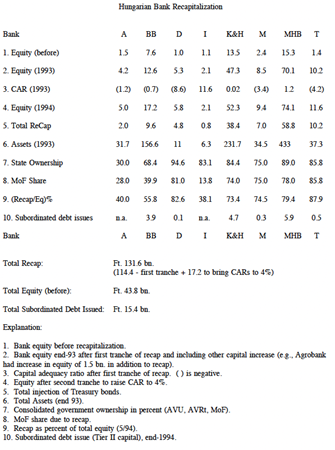
To assist firms and to inject capital into banks to raise their capital ratios to the 8% Basel accord minimum (Neale and Bozski 2001, 153).
Key Terms
-
Announcement DateDecember 1993, May 1994, December 1994 (IMF 1995, 155)
-
Peak UtilizationTotal: HUF 169.1 billion ($1.3 billion) (IMF 1995)
-
Eligible InstitutionsBanks whose capital ratios did not meet the regulatory standards in each phase. The rule was flexible, and larger banks tended to receive more capital (Balassa 1996, 15)
-
AdministratorGovernment, mostly led by the Ministry of Finance
-
Legal AuthorityThe recapitalization process was authorized by the Bank Consolidation Act of 1994. Parliament passed each process, taking a step-by-step approach (Balassa 1996, 32)
-
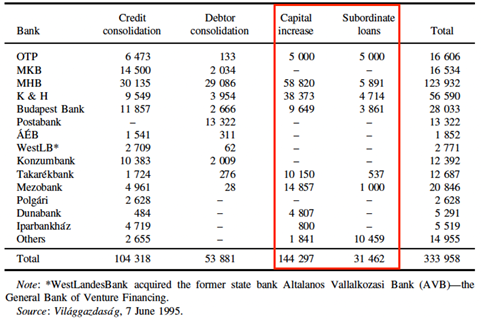
Notable FeaturesThe recapitalization was implemented in three stages (December 1993, May 1994, and December 1994) (IMF 1995, 155); the recapitalization prepared banks for privatization and purchase by foreign investors (Bonin and Schaffer 1995, 73)
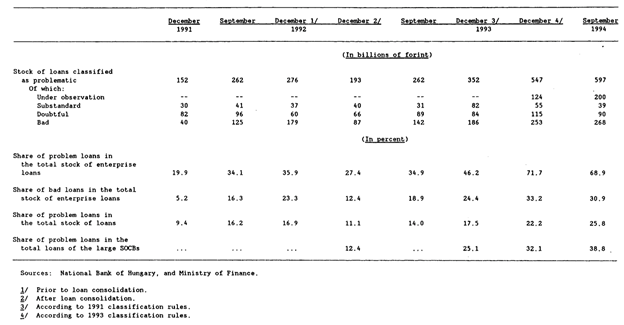 Source: IMF 1995.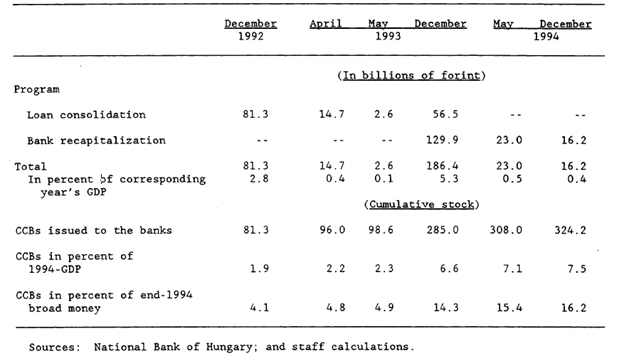
Key Design Decisions
Part of a Package
Governance
Eligible Institutions
Program Size
Source of Injections
Individual Participation Limits
Capital Characteristics
Restructuring Plan
Exit Strategy
Amendments to Relevant Regulation
Key Program Documents
Taxonomy
Intervention Categories:
- Broad-Based Capital Injections
Countries and Regions:
- Hungary
Crises:
- Hungary Banking Crisis 1990s