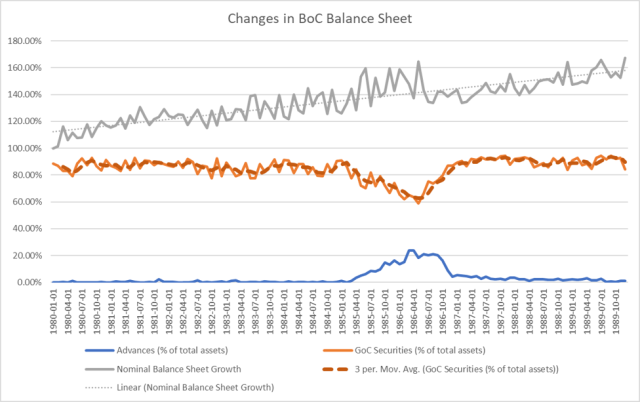
This case study is about the ad hoc emergency liquidity the Bank of Canada (BoC) provided to the Canadian Commercial Bank (CCB) from late March until the end of August 1985. This facility was part of a support package for CCB, which included a component aimed at restoring solvency; authorities liquidated the bank once the full extent of the problems with its loan book became apparent (MacIntosh 1991). (See Estey [1986] for a longer discussion of the solvency restoration efforts and the associated controversies.)
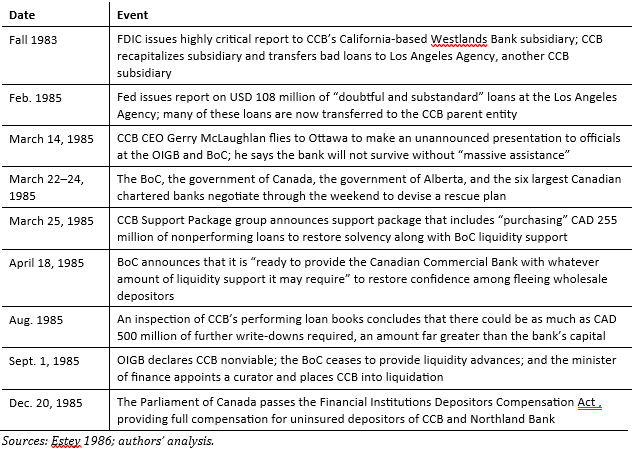
CCB faced issues including a concentrated loan portfolio, insufficient capital base, reliance on wholesale deposits, poor lending practices, and dubious accounting methods like capitalizing unpaid interest. The United States Federal Deposit Insurance Corporation (FDIC), which supervised CCB’s Westlands Bank subsidiary in California, identified these problems in the fall of 1983, issuing a “highly critical” report to the bank (Estey 1986, 82). To save Westlands and assuage FDIC concerns, CCB injected capital and transferred a number of problem loans to Los Angeles Agency, another US-based CCB subsidiary, which was supervised by the Federal Reserve Bank of San Francisco. In February 1985, the Federal Reserve Board (Fed) issued a report in which it deemed a portfolio of USD 108 million in predominately energy loans “doubtful and substandard” (Estey 1986, 82).
By early 1985, the bank was no longer earning a positive net interest margin because of its high proportion of nonperforming loans. The Estey Commission, a federally mandated investigation into the collapse of CCB and Northland Bank led by Supreme Court Justice Willard Estey, stated retrospectively, “No bank in this condition had a future and the CCB was no exception” (Estey 1986, 102). On March 14, 1985, CCB CEO Gerry McLaughlan flew to Ottawa to make unannounced presentations to officials at the BoC and the Office of the Inspector General of Banks (OIGB)—the Canadian bank supervisor at the time—in which he said the bank would not survive unless the government provided it “massive assistance” (Estey 1986, 105).Canadian authorities feared the prospect of a “tidal wave effect” on similarly situated regional financial institutions (Estey 1986, 107). They were also aware that the bank was “hopelessly insolvent,” as it faced immediate write-offs of CAD 244 million against CAD 130 million of capital (Estey 1986, 111). The CCB’s management proposed a rescue plan involving the “purchase of the aggregate loan losses” of CAD 244 million by the Canadian Deposit Insurance Corporation (CDIC) in exchange for share warrants and a 50% share of future profits until the funds were repaid (Estey 1986, 108). The CDIC at the time insured bank deposits up to CAD 60,000 per depositor. “Purchasing losses” meant obtaining a claim on a junior tranche of a CAD 530 million pool of nonperforming loans (Estey 1986, 492).
Following an assessment of the nonperforming loan pool, between March 22–24, 1985, Canadian authorities negotiated a modified version of the CCB plan with the intent of restoring CCB to viability. A consortium of the government of Canada, the government of Alberta, the CDIC, and the six largest Canadian banks announced on Monday, March 25, a support package consisting of a CAD 255 million loan to CCB, along with further liquidity support from the BoC as needed. This action preserved the assets side of CCB’s balance sheet. The OIGB explained in correspondence to the Department of Finance: “upon completion of the transaction, the Bank will receive [CAD] 255 million in cash and reduce the carrying value of its loan portfolio. There will be no other changes to the balance sheet of the Bank” (Estey 1986, 496). However, it is not clear how the CCB described the consortium package on the liabilities side of its balance sheet—as a loan or a type of equity—since CCB’s balance sheet for that period is not available. In the view of Justice Estey, “the [CAD] 255M, by the terms of the interim and final agreements, remains an obligation in debt of the CCB” (Estey 1986, 115). This loan was contingent upon the debenture holders agreeing to subordinate their claims to the advances made by the parties involved in the rescue program and the conditions of the repayment program called on the CCB to pay back 50% of its pretax profits to the consortium members until the capital on the refinancing deal was repaid in full (Estey 1986; LA Times 1985).
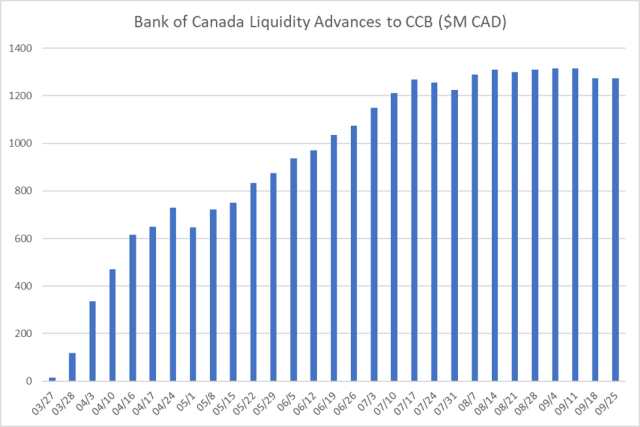
Immediately following the March 25 announcement of the support package, a number of CCB counterparties cancelled or declined to renew contingent lines of credit. The BoC said in an April 18 press release that it was “ready to provide the Canadian Commercial Bank with whatever amount of liquidity support it may require” (Estey 1986, 500). The CCB’s Canadian and US performing loan portfolios were used as collateral for the BoC’s liquidity support, in two stages. Initially, the Canadian loan portfolio was pledged, followed by the US loan portfolio after the full extent of the bank’s liquidity needs became apparent. There was no formal cap on lending against this, but the BoC stated afterward it was willing to lend at least 75% to 80% of the collateral’s book value (Bank of Canada 1986). The BoC relied on the OIGB for assessing the CCB’s collateral; the OIGB, for its part, mostly relied on external auditors hired by the CCB for its assessments (Estey 1986).
In May and June 1985, a team led by the manager of the Toronto-Dominion Edmonton commercial branch and a vice president of the BoC inspected CCB’s nonperforming loans and concluded around CAD 50 million in additional provisions would be needed. Following this inspection, the heads of the six support group banks met with the minister of finance and emphasized the need to determine whether the bank was solvent. In a final inspection of CCB’s loans, George Hitchman, a retired deputy chairman of the board of the Bank of Nova Scotia, concluded over the summer of 1985 that there could be as much as CAD 500 million of further write-downs needed. On August 13, the CCB admitted that it would be insolvent by the end of the fiscal year without further government assistance. After this point, following some deliberations on the options for resolving the bank, the authorities determined to liquidate CCB on September 1, 1985 (Estey 1986).
One immediate consequence of CCB’s failure was the decision to also liquidate Northland Bank, which was a smaller bank in a comparable, although less severe, condition (Estey 1986). Subsequently, the loss of depositor confidence in other regional Canadian banks resulted in “the virtual elimination of regional banks in Canada” through mergers and acquisitions (MacIntosh 1991, 225–226). The government of Canada effectively accepted responsibility for misleading investors as to the state of CCB and Northland and passed legislation agreeing to compensate all depositors, both insured and uninsured, with the CDIC paying out a total of approximately CAD 906 million across the entire banking sector in 1985 (CDIC 1986; CDIC 2016; MacIntosh 1991).
No information was found on whether the participating banks and government were paid back for the consortium loan.
At the end of 1986, the BoC’s outstanding advances to CCB stood at CAD 481 million, down from CAD 1.1 billion at the end of 1985 (Bank of Canada 1987). By the end of 1988, the outstanding combined advances paid out by the BoC to both CCB and Northland Bank stood at CAD 143 million (Bank of Canada 1989).
Figure 1: Timeline of the CCB Failure
 Source: Estey 1986.